minecraft enchanting table guide
A Minecraft enchanting table is a crafted block that lets you spend experience levels and lapis lazuli to add magical upgrades called enchantments to your tools, weapons, armor and books. It is one of the first machines every serious player builds because a single enchantment like Unbreaking or Sharpness can completely change how long your gear survives and how much damage it deals. Below is a complete guide covering the recipe the ideal bookshelf setup enchantability facts, and the best enchantments to chase first.
What Does An Enchanting Table Actually Do
The table works like a translator between your experience points and the game’s enchantment system. When you place a tool or piece of armor inside and add lapis lazuli, the game generates three possible enchantment offers based on your current level the item’s enchantability rating, and how many bookshelves are properly linked to the table.
Minecraft Enchanting Table Recipe
You only need three materials, though two of them are expensive early on.
| Item | Quantity |
| Obsidian | 4 |
| Diamond | 2 |
| Book | 1 |
Open a crafting table ,Minecraft APK and place the four obsidian blocks in a plus shape around the center put the book in the top middle slot, and slide a diamond into each side slot next to the obsidian. That arrangement produces one enchanting table ready to place in your world.
Get obsidian by pouring water over lava with a bucket, mine it with a diamond or netherite pickaxe and craft the book from three paper and one leather.
Setting Up The Table For Level 30 Enchantments
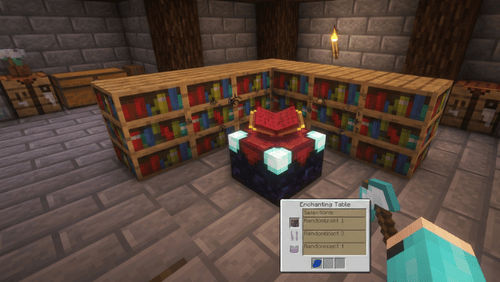
A bare enchanting table only offers weak low level enchantments. To reach the maximum enchantment level of 30, you need fifteen bookshelves arranged correctly around it.
The key rule is spacing. Each bookshelf has to sit exactly two blocks away from the table on the same level or one block higher with clear air in between. A common layout is a five by five ring with a one block gap left open somewhere for you to walk through stacked two shelves high in most spots to fit all fifteen without wasting space. If a torch carpet, snow layer, or any other block sits between the shelf and the table that shelf stops contributing entirely.
Once fifteen shelves are properly connected, the top offer in the enchanting menu will show level 30, meaning you need thirty experience levels banked up to claim it.
How Enchantment Levels And Enchantability Work
Each time you drop an eligible item into the table, the game rolls three separate offers using your bookshelf count and a bit of randomness layered on top. That is why two identical pickaxes placed in the same fully bookshelved table can show different results.
Enchantability plays a big role here too. Gold tools and leather armor have higher enchantability than diamond or netherite gear which can improve your chances of landing rarer or higher level enchantments although gold tools have very low durability so this trade off matters. Diamond and netherite items sit on the lower end of enchantability, which is part of why players often practice on cheaper gear first.
If you keep getting offers you do not want, temporarily blocking select bookshelves with torches lowers your effective bookshelf count and resets the pool of level requirements shown. Removing the torches restores full power once you are happy with your setup.
Lapis Lazuli Requirements
Lapis lazuli acts as the currency that unlocks each tier of offer, and the amount required scales with the enchantment level you select rather than always following a fixed number. Generally the top slot needs the least lapis and the bottom slot needs the most up to three pieces at full strength. You mine lapis lazuli as a blue ore, most commonly between Y level 0 and Y level 30 in current versions, so stock up before a big enchanting session.
Enchanting Books Instead Of Gear First
A smart habit many experienced players use is enchanting books rather than expensive equipment when farming for top tier results. Enchanting books lets you save useful enchantments for later and apply them to your preferred gear with an anvil making the process more flexible and reducing the risk of wasting valuable equipment on a bad roll. This way you can stockpile several strong enchantments over time and combine your favorites onto one perfect sword, pickaxe or chestplate.
Combining Enchantments With An Anvil
Once an item already carries one enchantment, the enchanting table can no longer touch it again. That is where the anvil comes in. Craft one using three blocks of iron and four iron ingots then use it to merge an enchanted book into your item, or combine two similar enchanted items together to raise a shared enchantment by one level for example turning two Sharpness II swords into a single Sharpness III sword. Anvils also repair durability and let you rename items, though repeated use raises the experience cost each time.
Removing Enchantments With A Grindstone
If you want a clean slate, a grindstone will strip every enchantment off an item and refund a small amount of experience though it also erases any custom name you gave it. This is handy for reworking gear you enchanted before you understood the bookshelf mechanics.
Best Enchantments To Get First
Once your table and bookshelves are ready here are the enchantments most players chase early.
Sword
Sharpness V, Looting III, Unbreaking III, Mending
Pickaxe
Efficiency V, Fortune III, Silk Touch, Unbreaking III
Armor
Protection IV, Feather Falling IV, Respiration III, Aqua Affinity
Mending in particular is worth prioritizing since it lets an item repair itself using collected experience orbs, which pairs well with any XP farm setup.
Common Enchanting Table Mistakes
- Using fewer than fifteen bookshelves and expecting level 30 offers anyway.
- Blocking bookshelves with torches, carpets or fences without realizing it disables them.
- Forgetting to stock enough lapis lazuli before a big enchanting session.
- Enchanting expensive diamond or netherite gear before practicing on cheaper items.
- Ignoring enchanted books which are the safest way to bank good rolls.
Works Across All Versions
This setup applies whether you play Minecraft Java Edition, Minecraft Bedrock Edition, Minecraft Education Edition, or console versions on Xbox, PlayStation and Nintendo Switch. The bookshelf spacing rules and enchantment mechanics stay consistent across platforms though menu navigation may differ slightly on console and mobile.
The Secret Language In The Interface
The glowing symbols floating around the enchanting table screen are written in the Standard Galactic Alphabet a substitution cipher that originated in the classic Commander Keen games. Fans have fully translated it over the years, but the text carries zero gameplay information and has no connection to which enchantment you will actually receive, so treat it as a cosmetic touch rather than a hint system.
Frequently Asked Questions
Conclusion
Building a proper enchanting setup takes some obsidian a bit of diamond mining and a well planned bookshelf ring but once it is running you will have a reliable pipeline for turning ordinary tools and armor into the strongest gear your world has to offer.